
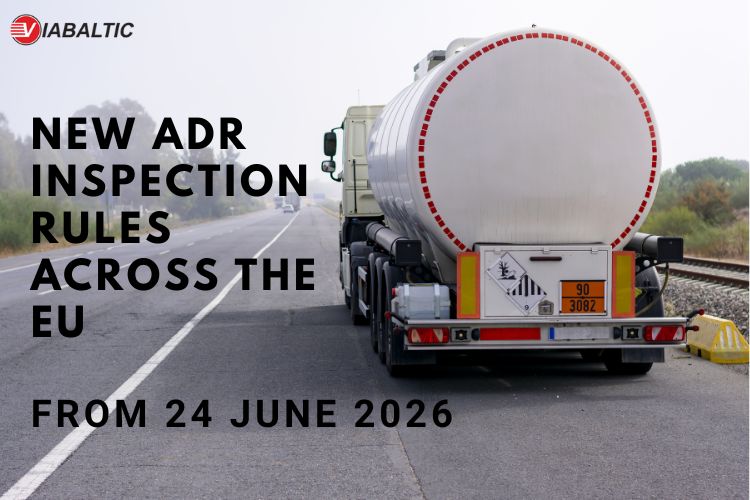
From 24 June, roadside inspections of vehicles transporting dangerous goods (ADR) will be carried out according to new harmonised rules across the European Union.
For Norwegian transport and logistics companies operating within the EU, the upcoming changes require particular attention. Although Norway is not a member of the European Union, Norwegian transport operators carrying out ADR shipments within the EU will be affected by the new inspection framework.
From 24 June, enforcement authorities across EU countries will apply the same assessment criteria during ADR inspections. This means that documentation, vehicle equipment, driver qualifications, and compliance procedures will be evaluated according to a more standardised system regardless of where the inspection takes place.
One of the most significant changes is the introduction of a standardised EU inspection checklist. Enforcement authorities throughout the EU will use the same inspection criteria during roadside checks, helping to ensure a more consistent approach to ADR enforcement across member states.
The checklist will cover areas such as vehicle approvals, transport documentation, safety equipment carried on board, vehicle markings, and compliance with ADR requirements for the transport of dangerous goods.
The new framework also introduces a risk-based classification of violations, allowing authorities to assess non-compliance according to its potential impact on safety.
The three categories are:
Examples of serious infringements include missing ADR transport documents, invalid ADR driver certificates, missing vehicle markings, or the transport of dangerous goods in unapproved packaging.
The updated rules reinforce the principle that ADR compliance is not solely the responsibility of the carrier. Other parties involved in the transport operation may also be held accountable, including consignors, loaders, packers, fillers, tank operators, unloaders, and consignees.
This highlights the importance of ensuring that all participants in the logistics chain understand and fulfil their ADR obligations.
Transport companies should focus on several key areas:
Companies should ensure that all drivers involved in the transport of dangerous goods hold valid ADR certificates. The same review should be carried out for other personnel whose duties require ADR-related qualifications or training.
Businesses transporting hazardous materials should confirm whether any of the products they handle are affected by updated classifications, revised hazard thresholds, or modified transport requirements.
The updated rules may affect the obligation to appoint an ADR Safety Adviser (Dangerous Goods Safety Adviser – DGSA). Companies should review whether new thresholds, exemptions, or operational changes alter their compliance obligations.
With authorities across Europe applying a common inspection methodology, transport companies should expect a greater focus on:
Any identified irregularities may result in delays, fines, or vehicle detention.
Keeping up with regulatory changes can be challenging, particularly for companies involved in international transport operations. However, maintaining compliance remains essential for ensuring safe, efficient, and reliable transport activities throughout Europe.
Companies are therefore encouraged to review their ADR procedures and documentation to ensure full compliance before the new inspection regime comes into force on 24 June. As enforcement authorities across the EU begin applying the new harmonised framework, an increase in roadside inspections and compliance checks may be expected during the initial implementation period.
source with checklist:
https://eur-lex.europa.eu/legal-content/EN/TXT/PDF/?uri=CELEX%3A32025L1801
VIABALTIC NORGE AS
Hanekleiva Næringspark
Orhusveien 76 , 3070 Sande i Vestfold