
Rising geopolitical tensions in the Middle East have caused a sharp increase in global oil prices, which is already affecting the road transport sector. For Norway, where a large part of food supply depends on imports from the European Union, this creates growing pressure on the entire logistics chain.
Fuel represents around one quarter of total road transport costs. This means that changes in oil prices quickly affect transport rates and eventually the price of goods in stores.
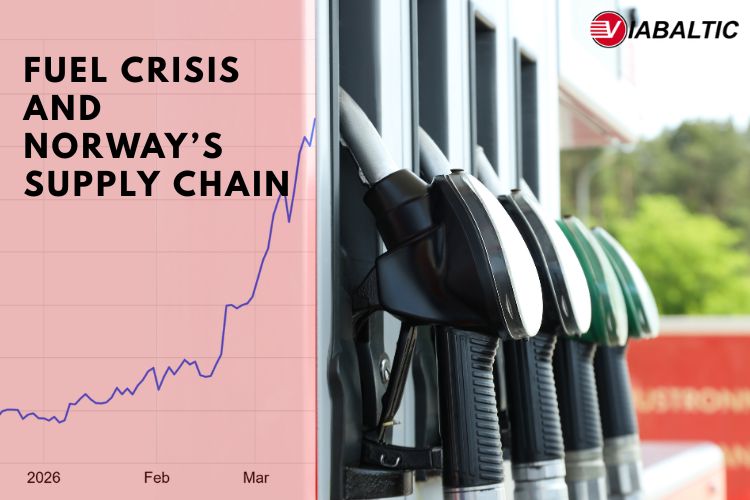
The situation on global markets has changed rapidly. Before the escalation of the conflict in the Middle East, a barrel of oil cost around 70 dollars, while recently the price exceeded 100 dollars, an increase of more than 30 percent.
At the same time, Norwegian authorities have indicated that government intervention would likely only be considered if the price reaches around 120 dollars per barrel.
It is also important to understand the structure of fuel prices in Norway. Roughly 30 percent of the price is the actual cost of fuel, while about 60 percent consists of taxes, including road tax, CO₂ fees and VAT. The remaining part of the price comes from distribution costs and fuel station margins.
To understand the potential impact of rising fuel prices, it is important to look at the structure of the transport market serving Norway.
Around 71 percent of international road transport to and from Norway is performed by foreign transport companies. The market is dominated by carriers from Central and Eastern Europe.
Polish and Lithuanian companies play the largest role. In recent years, Polish trucks transported more than 3.2 million tonnes of goods, while Lithuanian trucks transported about 2.6 million tonnes, making these two countries key operators in road transport serving the Norwegian market.
This means that the stability of food deliveries to Norway depends heavily on the economic situation of transport companies operating outside Norway.
In Poland, discussions about possible protective measures have already started. A proposed bill considers intervention if oil prices rise to 120–130 dollars per barrel.
The proposals include:
At the same time, Poland’s largest fuel distributor has already reduced its diesel margin almost to zero in order to limit the impact of rising fuel prices.
In Lithuania, the government is also considering different response measures. Among the options being discussed is the possible release of industrial fuel reserves in order to stabilize the domestic fuel market if prices continue to rise.
For Norway, this situation shows how strongly food supply chains depend not only on national policies but also on decisions taken in other European countries.
Rising oil prices create pressure on the transport sector, but the European logistics market has repeatedly shown strong ability to adapt. Hopefully, coordinated reactions from governments and the energy sector may still help limit the long-term impact on European logistics.
Sources:
https://www.nholt.no/artikler/2026/varsler-okte-transportkostnader/
https://energypedia.info/wiki/Fuel_Prices_Norway
https://www.bankier.pl/wiadomosc/Orlen-obnizyl-marze-na-diesla-niemal-do-zera-9095437.html
VIABALTIC NORGE AS
Hanekleiva Næringspark
Orhusveien 76 , 3070 Sande i Vestfold