
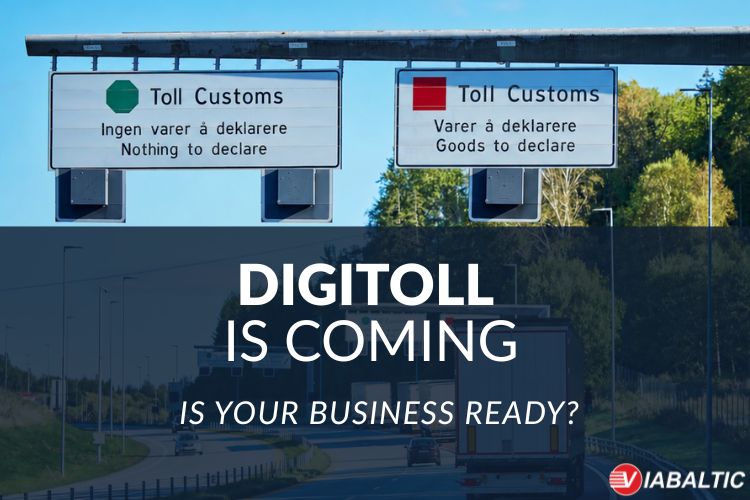
In short: Customs declarations are already submitted electronically through TVINN or NCTS. From 15 September 2026, it will also be mandatory to submit digital information in Digitoll about the transport and all consignments it carries. |
What will change and how to prepare your business?
Digitoll is one of the largest changes to the movement of goods into Norway in many years. The aim is to give Norwegian Customs information about which vehicle is arriving, when and where it will cross the border, which consignments it carries and which customs procedure applies to each consignment.
For importers, this mainly means that correct information must be ready earlier. The flow of information between the supplier, carrier, customs representative and consignee must also be clearly agreed.
But what changes if customs clearance is already electronic?
Today, customs declarations are submitted electronically through TVINN, while transit procedures are handled in NCTS. This will continue after Digitoll becomes mandatory.
The new part is that Norwegian Customs must also receive a complete digital picture of the transport and its cargo. A customs declaration explains what the goods are and which customs procedure applies. Digitoll shows, for example, which vehicle carries the goods, when and where it will arrive, and which consignments are included in the load.
System | What is submitted? | When is it used? |
TVINN | A customs declaration, for example for release for free circulation or customs warehousing. | For imports and other customs procedures. |
NCTS | A transit declaration and MRN. | When goods move under the transit procedure. |
Digitoll | Information about the transport, master consignment and each house consignment. | Mandatory digitally from 15 September 2026. |
Two important deadlines
15 September 2026: Digital notification and information becomes mandatory
From this date, information about the transport and the goods must be sent digitally to Norwegian Customs before, or no later than, the border crossing. In practice, the information should be sent well in advance so that any errors can be corrected before the transport arrives.
Digitoll includes three types of messages:
The messages must be connected using clear and matching references. Each consignment must also be linked to a declaration ID in TVINN, an MRN from NCTS, or another permitted reference.
1 March 2027: The direct transport scheme ends
Until this date, goods covered by the current direct transport scheme may generally be delivered to the consignee and declared within ten days after crossing the border. Correct registration at a customs warehouse and all other conditions must still be met.
From 1 March 2027, the customs declaration must be submitted before, or no later than, the border crossing. If the importer needs immediate access to the goods, they must be released for free circulation. If the goods are placed under the customs warehousing procedure, they must be taken to the warehouse stated in the declaration.
Important: From 15 September 2026 to 28 February 2027, the ten-day arrangement can still be used when its conditions are met. However, the transport and consignments must already be reported digitally in Digitoll. |
What must be ready before the vehicle reaches the border?
Norwegian Customs must be able to link the vehicle to every consignment in the load and each consignment to the correct customs procedure. If the references do not match, the information cannot be connected correctly.
Depending on the transport and type of goods, Viabaltic and the carrier will need information such as:
What happens at the border?
When the transport is registered as arrived, Norwegian Customs uses the submitted information for risk assessment and routing. A consignment may be allowed to continue, sent for inspection, or required to wait for a decision.
Complete information reduces the risk of unnecessary delays, but it does not guarantee that there will be no inspection. Norwegian Customs may always select a transport or consignment for control.
Digitoll does not remove documentation requirements. Invoices, transport documents, proofs of origin, permits and other required documents must still be correct and available. Physical documents must still travel with the goods when required by the rules.
What can happen if information is missing or incorrect?
Viabaltic Norge will help you through the change
As your customs representative, Viabaltic Norge can help prepare the declaration, explain which information is required and coordinate the necessary references with the other parties in the transport chain.
To do this efficiently, we need correct documents on time. We therefore recommend reviewing your procedures with your suppliers and carriers now.
VIABALTIC NORGE AS
Hanekleiva Næringspark
Orhusveien 76 , 3070 Sande i Vestfold